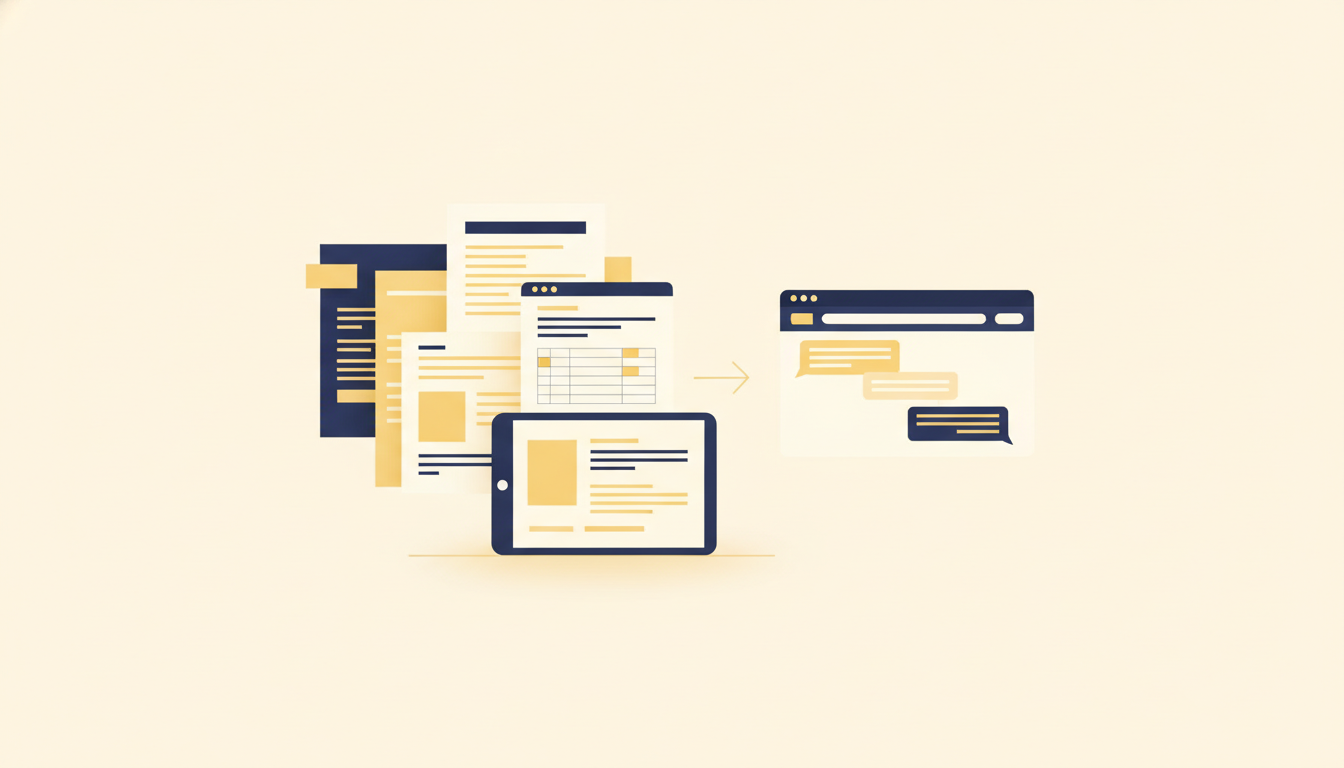
Understanding the Core Concepts of Retrieval-Augmented Generation
Standard language models rely heavily on the patterns learned during their initial training phase. While these models possess broad linguistic capabilities, they can sometimes generate generic statements or struggle with proprietary company policies. To address this limitation, developers turn to retrieval-augmented generation for chatbots.
As noted in the Google Cloud explanation of retrieval-augmented generation, this approach combines information retrieval with generative models to produce responses grounded in relevant external information. The system retrieves relevant passages and provides them as context before the model drafts a response.
How External Knowledge Bases Shape AI Responses
In a typical setup, an external knowledge base serves as the reference library for the assistant. When a user submits an inquiry, the system scans this library for matching passages. According to the AWS guide to retrieval-augmented generation, this process allows a language model to reference an authoritative knowledge base before generating its response.
This workflow helps reduce unsupported assumptions by feeding specific text snippets directly into the generation pipeline. Teams often utilize an AI knowledge base to store service hours, pricing guidelines, FAQs, and internal documentation.
The Retrieval and Generation Workflow
The mechanics of a retrieval system generally follow a distinct sequence of steps to prepare and present data. As detailed in the Microsoft introduction to RAG concepts, a RAG system prepares and retrieves relevant information before using it to generate grounded answers.
- Ingestion and Indexing: Documents are organized so the search mechanism can scan them efficiently.
- Query Matching: When a user asks a question, the system searches the index for matching content.
- Context Injection: Relevant paragraphs are added alongside the user prompt.
- Response Formulation: The model drafts a reply based on the retrieved context.
How HeyNaj Flow Implements Knowledge Retrieval
Applying these concepts to day-to-day operations requires a practical bridge between company files and customer-facing touchpoints. The current HeyNaj Flow implementation retrieves approved business knowledge from Google Drive and uses that context to help support relevant answers for the website widget.
HeyNaj Flow uses approved business documents from Google Drive as context for website widget responses. The available information depends on the documents the business has approved and maintained. This does not guarantee that every response will always be current or error-free.